
Douglas County Criminal Case Files
A Douglas County criminal court record is the District Court case file created after a charge is filed in court. It is held by the Clerk of the District Court as part of the court's official record. For state-law cases, the District Attorney reviews law-enforcement material and files the criminal matter in Douglas County District Court when prosecution goes forward. City ordinance and many city traffic or municipal criminal cases begin in Lawrence, Baldwin City, or Eudora Municipal Court instead.
Felonies in Douglas County are assigned to divisions that include Division 2 and Division 6. Misdemeanors are assigned to divisions that include Division 7 and the Pro Tem Division. The record can show the charging document, warrant or summons, bond, appearances, preliminary hearing entries, arraignment, plea, motions, trial entries, disposition, sentence, probation, fines, costs, restitution, and later expungement activity. For a closer look at the charge itself after arrest, use the court charge record path, but the final case outcome belongs in the criminal court file.
The Douglas County criminal defendants image from the county criminal defendants page shows the local court connection between custody questions and District Court criminal files.
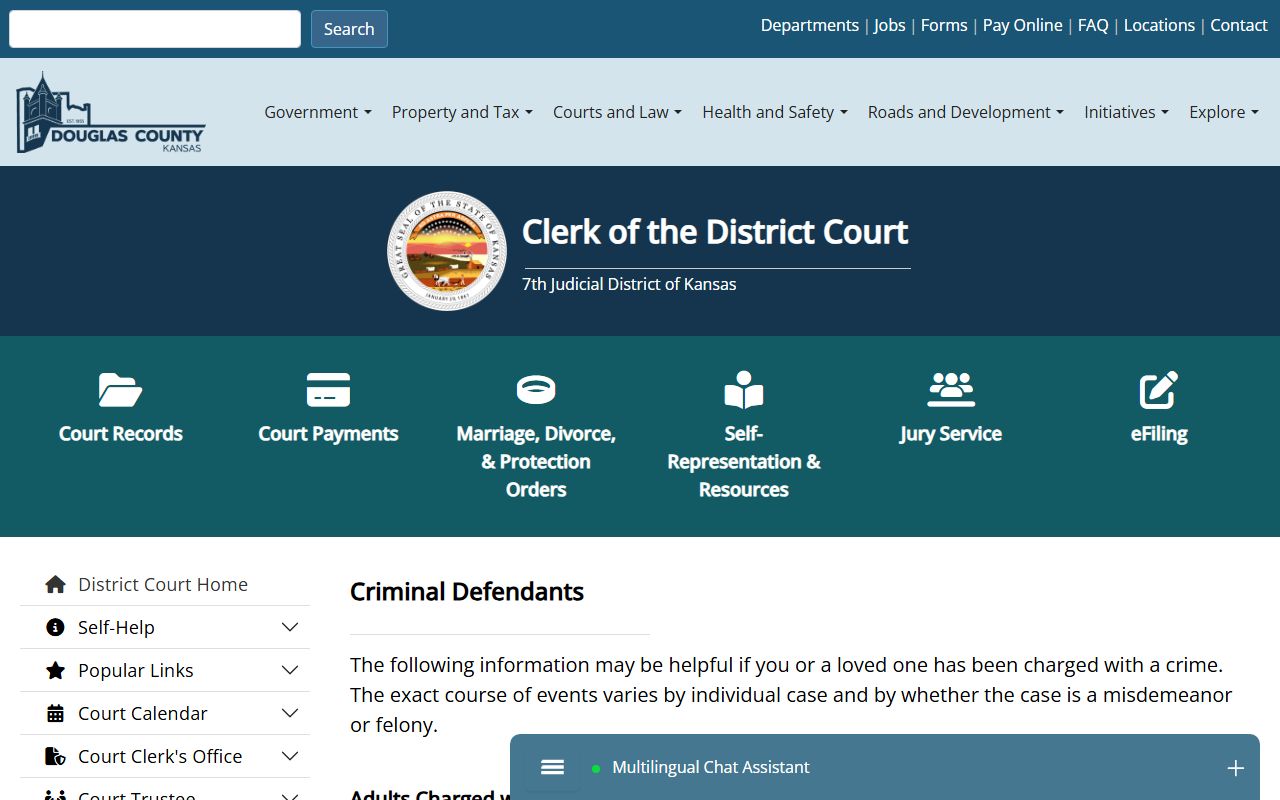
That court source points people looking for someone in custody to the jail, while the court file remains the source for case events and outcomes.
Search Douglas County Criminal Records
The main case search route is Kansas Case Search. Search by case number if available. If not, search by the defendant's name, then narrow by Douglas County, case type, date, and visible case status where the portal allows. If the online result is incomplete, use courthouse public access computers or contact the Clerk of the District Court. A certified copy, older file, sealed-record question, or official proof request should not rely on a screen view alone.
- Confirm whether the matter is a state District Court case or a Lawrence, Baldwin City, or Eudora municipal case.
- Search Kansas Case Search with the case number, defendant name, business name, citation, or other available criteria.
- Open the case result and check the court, county, filing date, parties, docket entries, hearings, and status.
- Read disposition and sentencing entries carefully because a charge may be dismissed, amended, diverted, or resolved by plea or trial.
- Request copies through the Clerk of the District Court when the online case record is not enough.
The Douglas County District Attorney discovery procedures source is separate from public case search. Discovery is the exchange of case material in a prosecution, not a public portal for every person to view criminal evidence. Public users should look to the court case record, the clerk, or formal records channels unless they are a party or attorney using the proper criminal-case process.
The discovery procedures image from the District Attorney discovery page supports the distinction between criminal case filings and prosecution discovery.
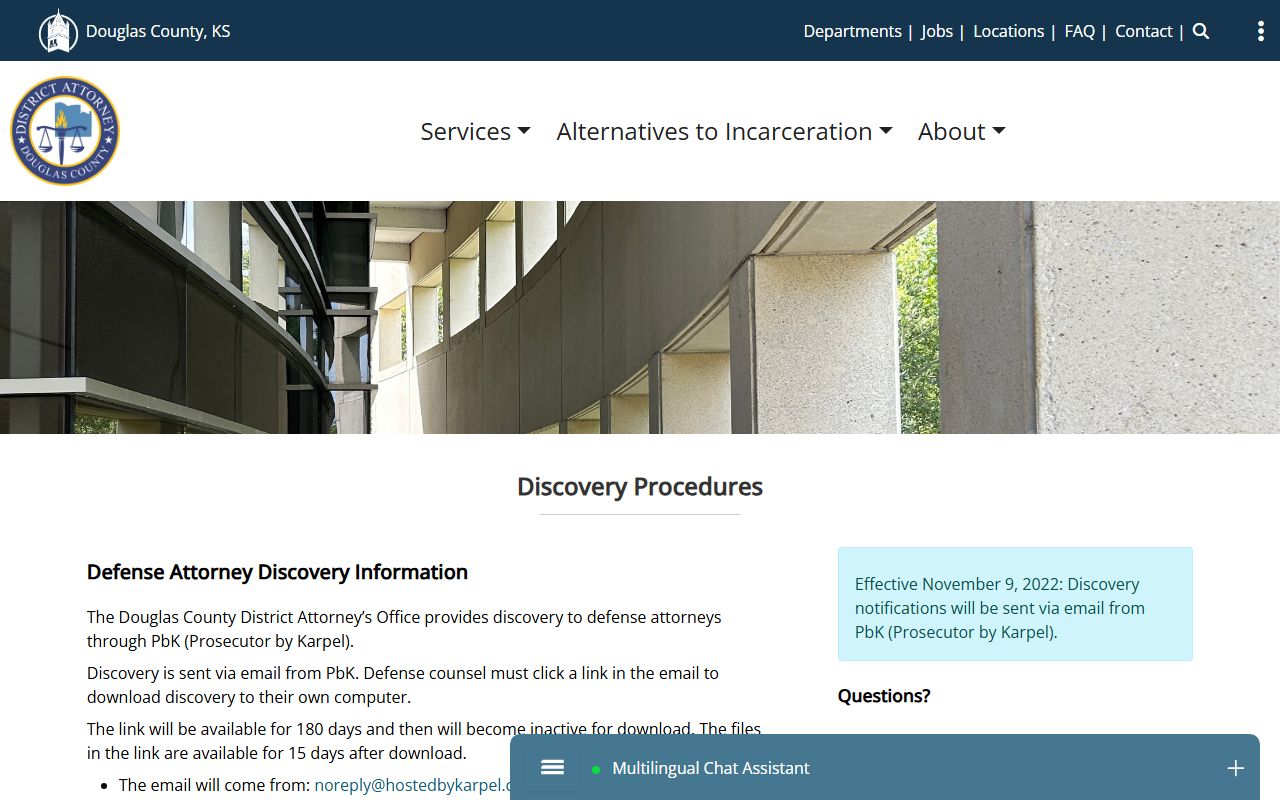
Discovery procedures can matter to defendants and attorneys, but the public criminal court record is still the case file maintained by the court.
Douglas County Criminal Case Flow
Criminal court records are easiest to read in sequence. A case may begin with a complaint or information, then move through appearance, bond, preliminary hearing, arraignment, motions, plea, trial, disposition, and sentencing. Not every case has every step. A misdemeanor may move more quickly than a felony. A diversion can pause prosecution and lead to dismissal if terms are met. An expungement entry may appear much later after a judge seals public access to a qualifying record.
Case flow: Charges Filed › First Appearance / Bond › Preliminary Hearing or Arraignment › Pretrial / Motions › Plea or Trial › Disposition › Sentencing › Probation, Payment, Appeal, or Expungement
| Stage | What the Record May Show |
|---|---|
| Charges filed | Complaint, information, citation-linked filing, count numbers, offense description, and filing date. |
| First appearance / bond | Appearance entry, bond amount or condition, release status, counsel, and next hearing. |
| Preliminary hearing / arraignment | Probable cause step for felony cases, plea entry, and formal case scheduling. |
| Pretrial / motions | Continuances, discovery issues, suppression motions, orders, and trial settings. |
| Plea or trial | Guilty plea, no contest plea, verdict, acquittal, dismissal, or amended charge result. |
| Disposition / sentencing | Outcome, sentence, probation, jail or prison term, fines, costs, restitution, and conditions. |
Douglas County Criminal Records Fields
The criminal case file is a field-by-field record of what the court did. It does not prove every allegation in a police report, and it does not show every jail event. Instead, it tracks what was filed with the court, what the judge ordered, what the parties did in court, and how each charge or count was resolved. A reader should compare the charge section with the disposition and sentence before drawing any conclusion.
| Field | What It Shows |
|---|---|
| Case Number | The Douglas County District Court identifier for the criminal file. |
| Defendant | The person charged, with identifying details redacted where required. |
| Prosecuting Party | The State of Kansas or, in municipal matters, the city prosecutor. |
| Charges / Counts | The offense allegations filed in court, including amended or dismissed counts when visible. |
| Bond | Release conditions, bond amount, or custody-related entries when part of the court file. |
| Hearings | Dates and event types such as first appearance, arraignment, motion, trial, sentencing, or review. |
| Motions and Orders | Requests by parties and rulings by the judge. |
| Plea / Verdict | Guilty, not guilty, no contest, acquittal, dismissal, or other resolution entry. |
| Disposition | The outcome for the case or charge, including dismissal, diversion, conviction, or closed status. |
| Sentence | Jail, prison, probation, fines, costs, restitution, treatment, or other court-ordered terms. |
| Expungement Activity | Petitions, orders, or status changes that restrict ordinary public access. |
Charges vs Convictions
A charge is an accusation filed in court. A conviction is a court outcome after a guilty plea, no contest plea accepted as a conviction, or verdict of guilt. Douglas County criminal court records can show charges that were dismissed, reduced, amended, diverted, or resolved by acquittal. That is why the disposition field is essential. Reading only the first charge line can overstate what happened in court.
| Point | Charge | Conviction |
|---|---|---|
| Meaning | An allegation filed by the prosecutor or charging authority. | A final guilty outcome by plea or verdict. |
| Where seen | Complaint, information, citation-linked filing, amended count, or docket entry. | Disposition, plea, verdict, judgment, and sentencing entries. |
| Can change | Yes. It may be amended, reduced, dismissed, or diverted. | It can be appealed, corrected, or expunged if the law and order allow. |
| Use caution | Do not treat a filed charge as proof of guilt. | Check sentence, probation, fines, and later expungement activity. |
The Kansas criminal history image from the Kansas criminal history record check source shows a separate statewide background-check route.
A Kansas criminal history check is not the same product as the Douglas County court file, so results should be compared carefully.
DA and Specialty Dockets
The Douglas County District Attorney's Office prosecutes state criminal cases and is located at the Judicial and Law Enforcement Center. The current research identifies Suzanne Valdez as District Attorney and lists the office at 111 E. 11th Street, Unit 100, Lawrence, KS 66044-2912, with public hours Monday through Friday, 8:30 a.m. to 5:00 p.m. The DA's public role matters because the criminal court record begins after prosecutor review and filing, not simply when a person is arrested or booked.
Douglas County also has criminal-case assignments with specialty context. Division 5 is tied to Drug Court, probation violations, and care and treatment. Division 6 is tied to felonies, expungements, and Behavioral Health Court. The research did not locate official program eligibility, participant counts, outcomes, or a Douglas County-specific public defender office page, so those details should not be invented. The useful record point is narrower: specialty docket entries, attorney appointments, or counsel changes may appear in the criminal case file when they are part of the court record.
Public Access to Criminal Records
Kansas law favors access to public records unless another law closes or limits the record. K.S.A. 45-216 states the public policy that records are open unless otherwise provided. For court records, that policy works with court-specific rules, Kansas Case Search, clerk access, public access computers, and confidentiality rules. Douglas County also warns that its court-record request form is not the official court case record under Kansas Supreme Court Rule 106B.
Criminal court records are often public in part, but not always complete online. Juvenile official files, sealed cases, expunged records, protected personal identifiers, medical or treatment information, abuse or stalking-sensitive data, and some affidavits or sworn testimony can be restricted. The clerk can explain copy access, but the clerk cannot give legal advice or override a sealing order. For city criminal or traffic matters, the municipal court should be checked first.
Key access point: Use the court case file for pleas, dispositions, and sentences, not a booking page or arrest report alone.
Sealed vs Expunged Records
Douglas County describes expungement as asking a judge to seal the court record of a previous criminal or juvenile offense. Kansas Self-Help provides record expungement resources. If the case was filed in District Court, the petition goes through the Clerk of the District Court. If it was a Lawrence, Baldwin City, or Eudora municipal case, the municipal court is the better starting point. Expungement does not always mean every agency copy disappears.
| Point | Sealed | Expunged |
|---|---|---|
| Public view | Hidden or limited by court order, statute, or confidentiality rule. | Ordinary public access is sealed or removed for a qualifying record after court approval. |
| How it happens | May happen by case type, statute, judge order, or redaction rule. | Usually requires a petition, eligibility review, notice, and judge's order. |
| Examples | Juvenile files, protected addresses, mental health details, sealed affidavits, or personal identifiers. | Qualifying criminal, arrest, diversion, or juvenile offense records after the required process. |
| Limits | Courts, law enforcement, prosecutors, or agencies may retain limited lawful access. | Law-enforcement, licensing, court, prosecutor, or statutory exceptions can still apply. |
The Kansas expungement image from Kansas Self-Help record expungement shows the state resource Douglas County users can consult after identifying the case.
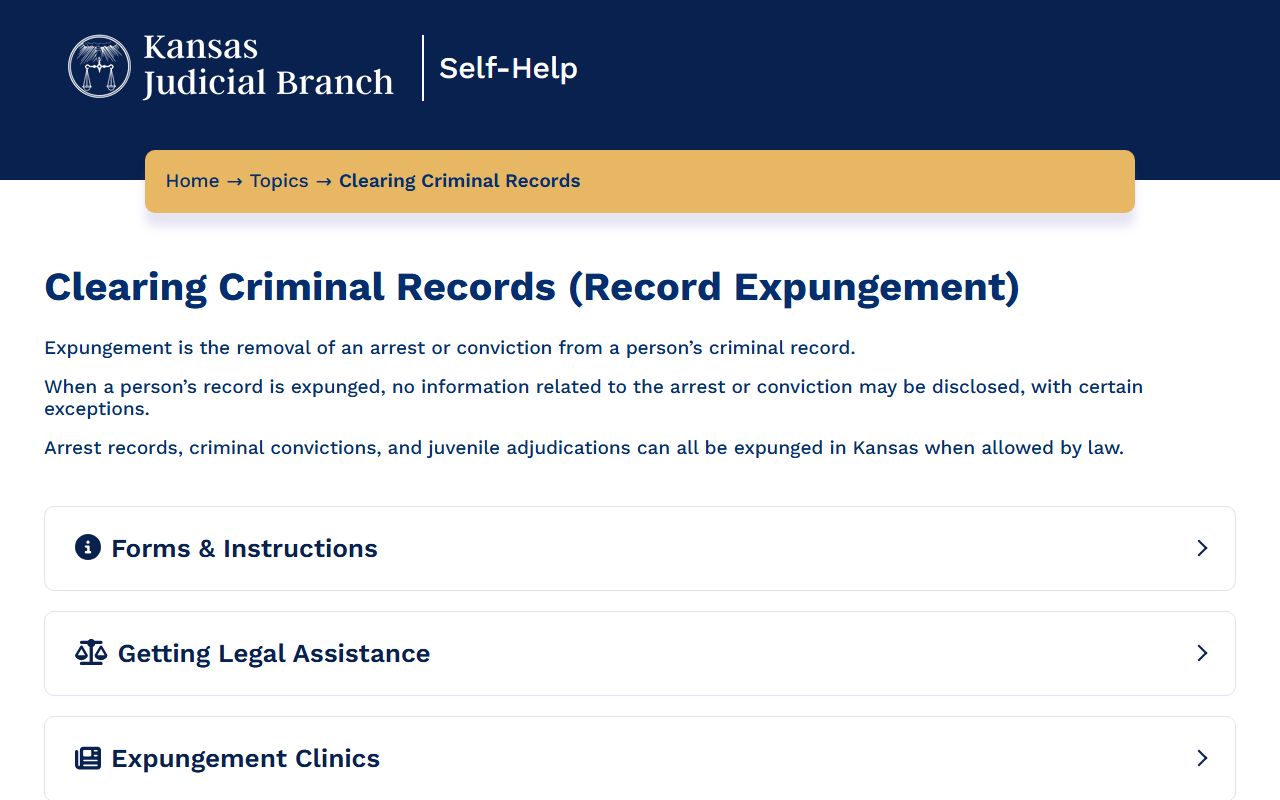
Expungement should be described as a court-ordered access limit unless the specific order or statute says more.
Restricted Criminal Record Sources
Juvenile criminal-type records have a separate access rule. K.S.A. 38-2309 controls juvenile official files and disclosure. That matters in Douglas County because juvenile offender and Child in Need of Care matters are handled in the juvenile division, and those files are not treated like routine adult criminal dockets. Adoption, mental health, care and treatment, and protected minor information can also be restricted.
State databases can answer different questions. The KBI Registered Offender Website concerns registered sex, violent, and drug offenders, not every Douglas County criminal case. A person may have a court record without appearing on a registry. A person may also have a registry entry that should be read with the exact conviction, sentence, and registration statute. For full local court context, the District Court criminal case file remains the better source.
The juvenile official file image from K.S.A. 38-2309 supports the special handling of juvenile criminal-type files.
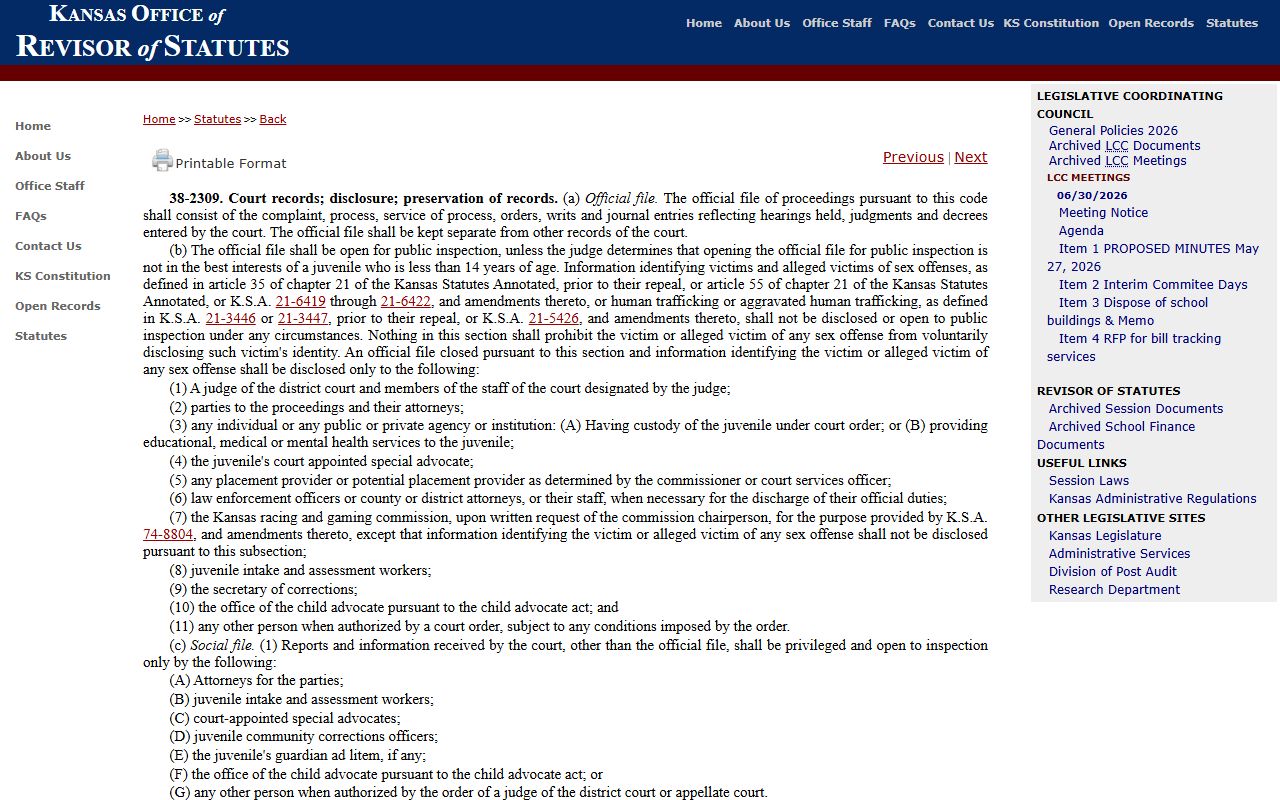
Juvenile restrictions are a hard boundary, so public search results should not be assumed incomplete by mistake when a file is legally closed.
The KBI offender source image from the KBI registered offender search shows a registry source that should be kept separate from the county criminal case file.
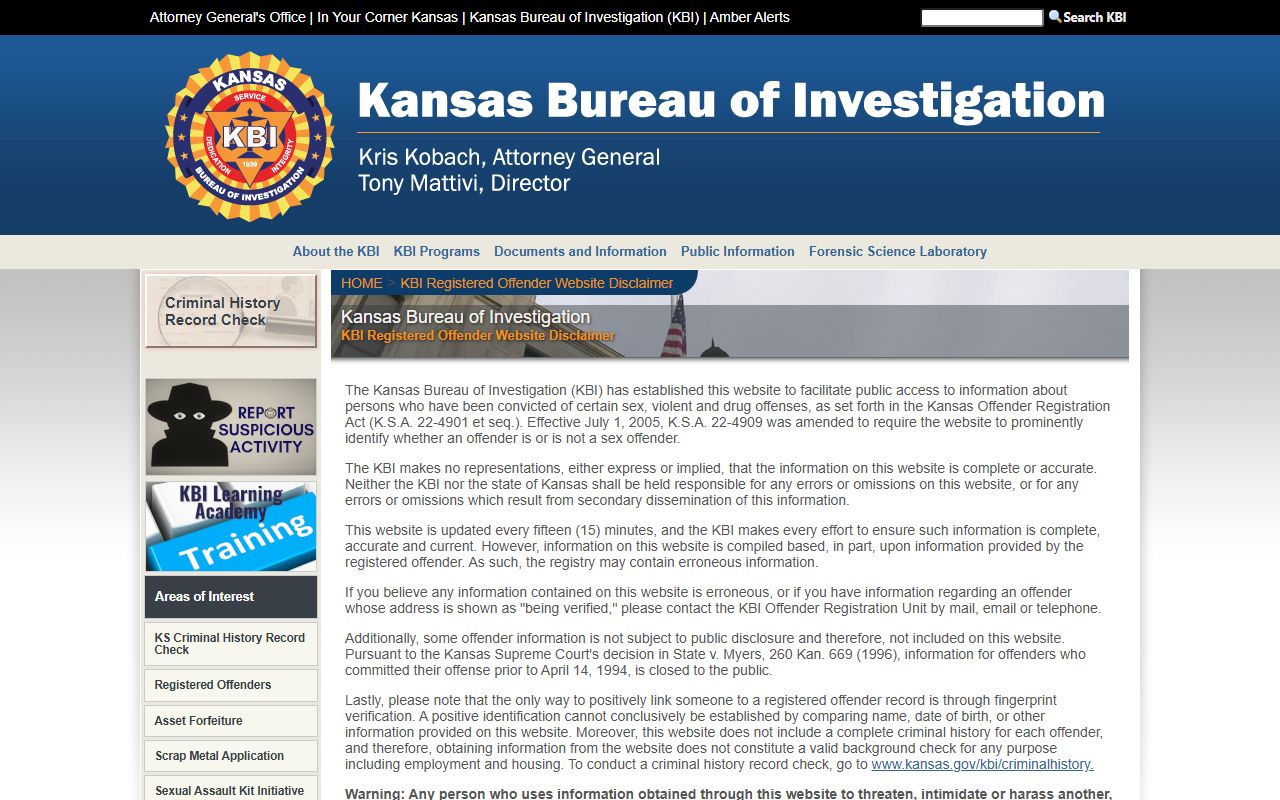
Registry searches may be useful for a narrow public-safety question, but they do not replace the court record's charges, plea, disposition, and sentence.
Note: A criminal court record can be public, partly redacted, sealed, expunged, or unavailable online depending on case type and order.