
Douglas County Arrest Records and Court Charges
Arrest records in Douglas County come from the law-enforcement side of the process. The Douglas County Sheriff's Office publishes inmate reports that can show recent bookings, current custody, and bond information. Those reports help confirm whether a person was booked into the Douglas County Correctional Facility or is listed in the current in-custody roster, but they are not the same thing as the formal court charges filed after arrest.
The court charge record starts when a prosecutor files a charging document in the Douglas County District Court. The Douglas County District Attorney's Office prosecutes state-law criminal cases after law enforcement submits reports for review. A single booking may lead to no charge, one charge, or several charges. Charges can also change after first filing, so the booking report, the bond report, and the court case record should be read together.
For booking and custody detail, the better route is the Douglas County inmate records page. For the full criminal case file, including pleas, motions, dispositions, and sentences, use criminal court records. This charge-focused path sits between those two records: it explains how the arrest becomes a court case and how to read the charge list before assuming it is a conviction.
Find Douglas County Arrest Records and Charges
Start with the source that matches the fact being checked. The DGSO inmate reports are useful for recent custody, booking recaps, and bond amounts. The District Court case route is better for charges filed in court, charge status, hearing dates, and disposition. Douglas County's court records page points users to Kansas Case Search, the statewide district court public case information portal.
- Check the DGSO Booking Recap Report when the question is whether an arrest or booking occurred during the recent reporting period.
- Use the In Custody Report or Bond Amounts Report if the person may still be held or may have a bond tied to the arrest.
- Search Kansas Case Search by case number, person name, business name, or citation when the question is whether court charges were filed.
- Open the District Court case result and read the charge list, docket entries, hearing dates, and current case status.
- Contact the Clerk of the District Court records office for official copies, older records, certified copies, or records that do not appear online.
Douglas County warns that its court-record request form is not the official court case record under Kansas Supreme Court Rule 106B. That warning matters for charge research. A name search or county information response may help find a case, but legal, employment, licensing, credit, or court-proof uses should be verified with official court case records or certified clerk copies.
The Douglas County District Attorney publishes traffic diversion information for eligible matters handled by the prosecutor.
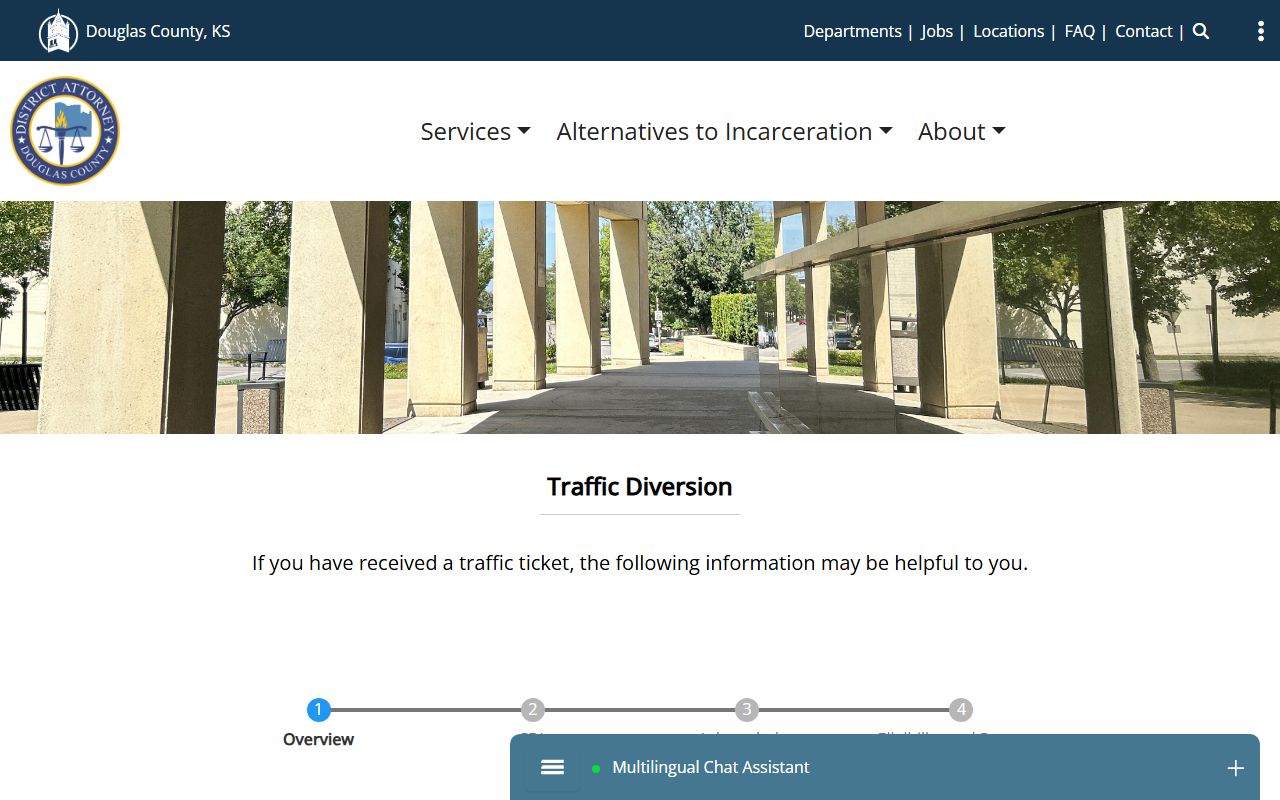
Diversion is important because a charge can appear in the court path without ending as a conviction if the agreement is completed and the case is dismissed as allowed.
Charges After Arrest Documents
Formal charges after arrest are not created by the jail roster alone. Prosecutor review is the point where reports, officer statements, witness information, citation facts, and available evidence become a charging decision. In Douglas County state cases, that review is tied to the District Attorney's Office. In Lawrence, Baldwin City, and Eudora ordinance cases, municipal court and city prosecutors may be the correct path instead.
| Document | Who Files It | What It Does | Douglas County Use |
|---|---|---|---|
| Complaint | Prosecutor or authorized charging authority | States the alleged offense and starts the criminal case or count. | Common in criminal and traffic misdemeanor filings. |
| Information | Prosecutor | Sets out formal charges after prosecutor review, often after probable-cause steps. | Used for many felony prosecutions in District Court. |
| Indictment | Grand jury | Charges returned by a grand jury rather than by complaint alone. | Less common for routine county-level filings, but still a charging-document type. |
Each charge should be read as an allegation until the case reaches a plea, verdict, dismissal, diversion result, or other disposition. Kansas Case Search and clerk records may show the charge text, statute or ordinance reference, severity level, filing date, hearing history, and later status. Not all documents are downloadable online, and some affidavits, sworn testimony, juvenile records, and sealed items require separate access review.
Douglas County Charge Status
Charge status changes often explain why a booking report and a court record do not match. An initial arrest may list one suspected offense, while the filed complaint or information lists a different count. Later, the prosecutor may amend a charge, reduce the severity, dismiss a count, add a count, or resolve the matter through diversion. Always check the latest docket entry and the final disposition before treating the first charge as the outcome.
| Status | What It Means | How to Verify |
|---|---|---|
| Pending | The charge is still open and no final disposition has been entered. | Check upcoming hearings, bond entries, and docket settings. |
| Amended or reduced | The filed charge changed, often by count, statute, severity, or factual wording. | Compare original and later complaint, information, or docket entries. |
| Dismissed | The court or prosecutor ended the charge without a conviction on that count. | Read whether dismissal is tied to plea terms, diversion, proof issues, or other orders. |
| Diversion | The defendant enters an agreement that may lead to dismissal if all terms are met. | Review the diversion agreement, compliance dates, and later dismissal entry if public. |
| Nolle prosequi | The prosecutor declines to continue prosecution on a charge. | Look for a prosecutor filing or docket entry using that term or a similar dismissal entry. |
Note: One arrest can produce several charges, and each count can have a different status or outcome.
Charges vs Convictions
Being charged is not the same as being convicted. A charge means the government alleges a violation and has opened a court path. A conviction means the charge ended with a guilty plea, no-contest plea accepted as a conviction where applicable, or a guilty verdict. Douglas County criminal court records may also show charges dismissed after plea negotiations, charges dismissed after diversion, acquittals, or counts that were never filed after the arrest.
| Point of Comparison | Charge | Conviction |
|---|---|---|
| Meaning | An accusation filed with a court. | A final guilt finding or accepted plea on a count. |
| Record location | Complaint, information, indictment, docket, or case summary. | Disposition, journal entry, sentencing entry, or judgment. |
| Can change? | Yes. It can be amended, reduced, dismissed, or diverted. | Only changed by later court order, appeal, withdrawal, or expungement process. |
| Background use | Needs careful context because it may not show guilt. | Still must be verified against the court's final record. |
The Kansas criminal history record check is a separate statewide route operated through Kansas.gov and KBI-related systems. The research file identified a listed $30 fee for that service. A state criminal history search is not the same as reading a Douglas County District Court case file, but it may be the better path when a statewide official history is needed.
Charge Codes and Severity
Douglas County criminal filings may include statute references, offense names, severity levels, and court case types. Felony matters are handled in District Court divisions that hear felony work, while misdemeanors and district traffic misdemeanors or infractions may be assigned to other divisions or pro tem settings. City ordinance and many city traffic matters stay with municipal courts unless appealed or otherwise routed to District Court.
Statewide custody or supervision status should be checked through the right system. The KDOC KASPER offender locator is for state prison or supervision records, not current Douglas County jail booking detail.
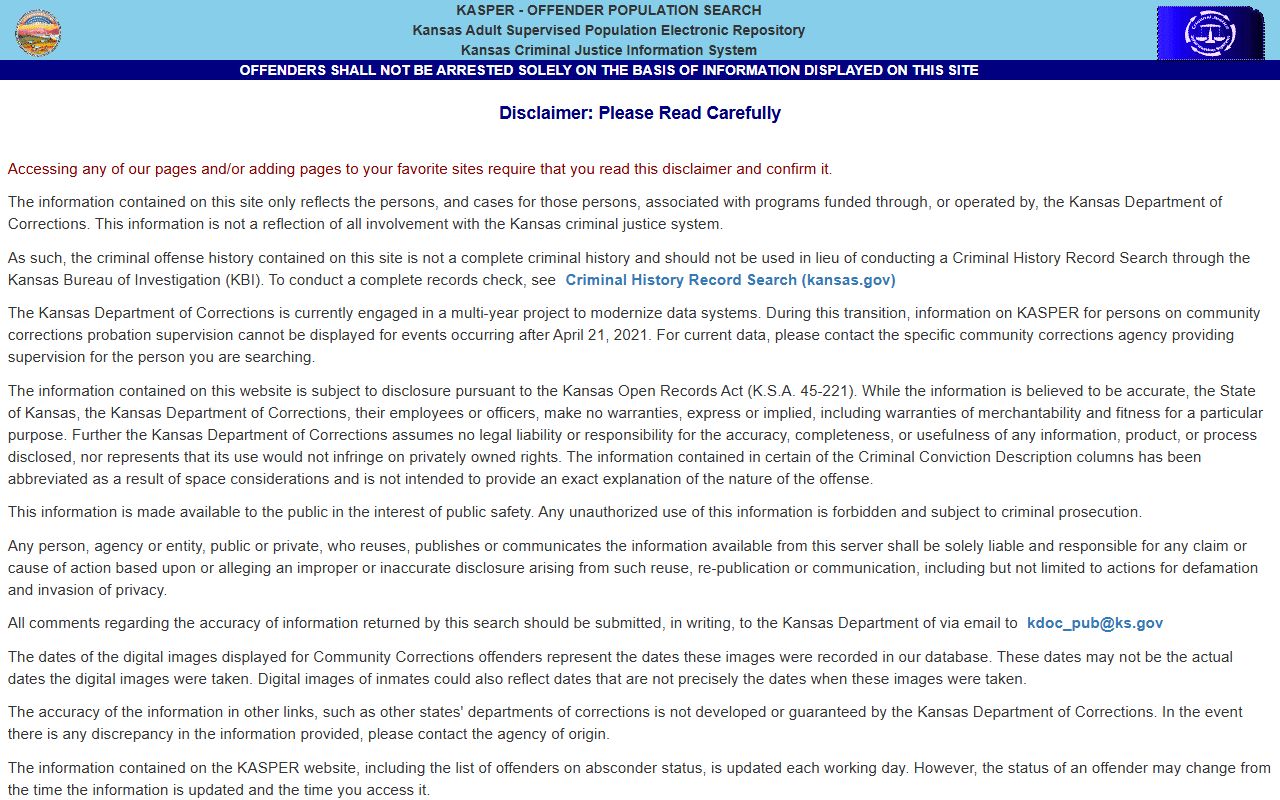
KASPER can help after sentencing or supervision begins, but it should not replace the District Court case record when the question is what charge was filed after a Douglas County arrest.
The KDOC locating a resident FAQ explains the state resident-locator path for people in KDOC custody.

That state locator is most useful after a case moves beyond local booking and court charging into state correctional custody or supervision.
Municipal Charges After Arrest
Douglas County has a clear split between state District Court and municipal court paths. The District Court page states that Baldwin City, Eudora, and Lawrence maintain separate municipal courts. A felony arrest or state misdemeanor generally points to District Court. A city ordinance citation, many city traffic matters, and municipal missed-court issues may point to the city court instead.
Lawrence Municipal Court publishes traffic arraignment and criminal arraignment information. Its FAQ says a person who misses court must come to Municipal Court on a weekday morning to be added to the docket, and if a warrant has issued the prosecutor will not speak with the person before the judge appearance. Baldwin City publishes municipal court and payment information, while Eudora has an online municipal payment/search page that supports search by vehicle information or name.
Expungement and Diversion Records
Expungement means asking a judge to seal a qualifying criminal, arrest, diversion, or juvenile offense record from ordinary public access. Douglas County's Court Records page links to Kansas expungement resources, and Kansas Self-Help publishes a record expungement route. Expungement does not mean every government use disappears. Court, law-enforcement, prosecutor, licensing, and statutory exceptions can still matter.
| Record Treatment | Public Effect | Douglas County Caution |
|---|---|---|
| Sealed | Hidden or limited from ordinary public view. | Some agencies may still have access under law or court order. |
| Expunged | Sealed from ordinary public access after a qualifying court order. | Do not assume destruction unless the specific order or law says so. |
| Diversion completed | May lead to dismissal if conditions are met. | The agreement, dismissal, and arrest record may need separate review. |
For victim custody notification, Kansas VINE provides a statewide status and notification route.

VINE is helpful for custody-status alerts, while the court record remains the source for charge filing, hearings, and case disposition.
Public Access and Limits
Kansas public access begins with the principle in K.S.A. 45-216 that public records are open unless law provides otherwise. K.S.A. 45-218 covers inspection requests and agency responses, while K.S.A. 45-221 lists records not required to be disclosed. Court records also follow court-specific rules, sealing orders, redaction practices, and access limits.
Restricted charge records can include juvenile official files under K.S.A. 38-2309, sealed or expunged charges, adoption-related files, mental-health or care-and-treatment records, protected addresses, minor information, Social Security numbers, financial account numbers, and some affidavits or sworn testimony. Douglas County separately links a request route for disclosure of an affidavit or sworn testimony, which signals that warrant-related sworn materials may need a special request rather than a normal case search.
Background Check Considerations
Casual record searches and official background checks serve different purposes. A booking recap may show a recent arrest. A court case may show filed charges and later status. A certified court record proves what the court actually entered. A Kansas criminal history search may provide statewide history through a separate official system. Those sources should not be mixed without checking the date, jurisdiction, case number, and final disposition.
Important: This private website is not a consumer reporting agency and cannot be used for FCRA-regulated screening decisions.